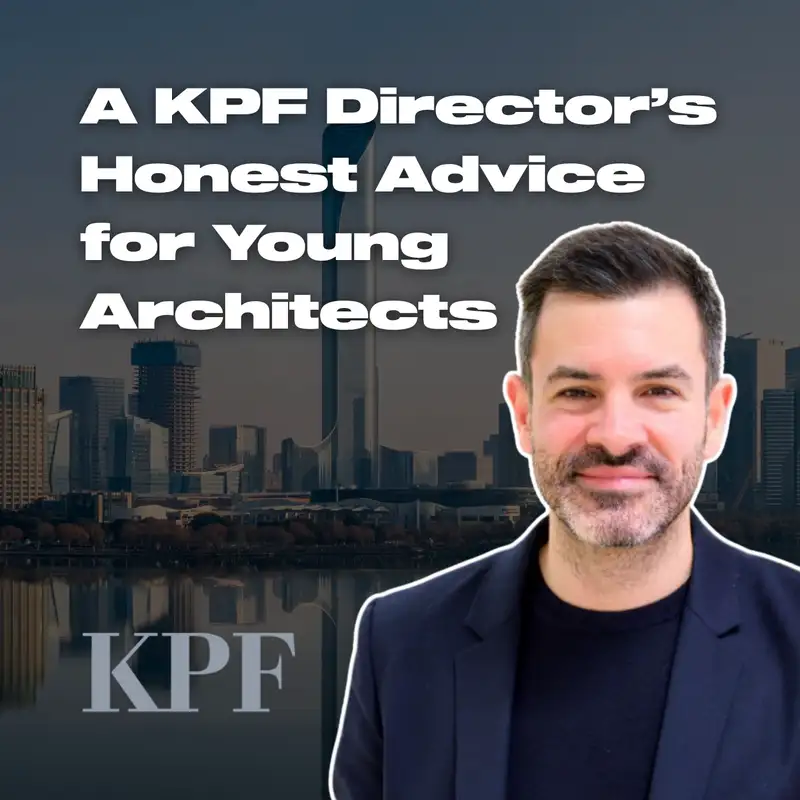
A KPF Director’s Honest Advice for Young Architects
Summary
Stephen Drew speaks with Francesco Casella, Director at KPF, about building a long-term architecture career inside a global practice, including hiring, progression, leadership, BIM, AI and the skills that still matter.Untitled - April 14, 2026
00:00:00 Stephen Drew: Hello everyone, and welcome to the Architecture Social show there. On this episode I am talking to an architect who is director of the London practice of Cpaf. Now, this is a large company that we might have seen in America, in London, but this architect in particular also has a journey to how they got here. And we're going to learn together all of the cool bits and all the tips and tricks that this person has learned. So hopefully we can swipe and deploy them into our own careers as well. So on that note, I have the fantastic Francesco Casella, who is a director at Kpf. Francesco, how are you, my friend? Are you okay?
00:01:37 Francesco Casella: Very good. Thank you, Steven, and thank you for having me.
00:01:40 Stephen Drew: Wow. The pleasure is all mine. I know you've got all these cool projects, so I appreciate borrowing your time on this. Now I get these opportunities for you and far between. But before we go, talk about all the cool projects you currently on and the ones that we can talk about, you know, because I don't want to break any, NDAs or anything. But before we go to that, maybe we can zoom back because I'm a Welsh person myself and I came to London to study architecture. But your roots, you grew up in a small town in Italy. Do you want to win me back to your journey of becoming an architect from the grass roots back at home?
00:02:20 Francesco Casella: Uh, yeah. Sure. So, I mean, it was driven mostly by curiosity and necessity. I, as you say, I grew up in a small town just outside of Padova, outside Padova, uh, in the northeast of Italy. Uh, and, uh, I remember at the time when my mom would take me to the city to discover the escalators and, uh, that for me was really, uh, it was the center, right? It was the verticality, the energy, the, the, the, the, the moment when you discover a city. And in retrospect, there were a lot of ingredients there, uh, which would talk about the life that I would, uh, have later on. Uh, and so I really wanted to live in a big city and I thought I would end up there. Uh, and, uh, big city was, uh, for me, just an abstract something that will come at some point.
00:03:16 Stephen Drew: Yeah. Fair enough.
00:03:18 Francesco Casella: Yeah.
00:03:19 Stephen Drew: Carry on. Yeah, yeah.
00:03:21 Francesco Casella: No. And then and then, uh, the, uh, the story after that, uh, Venice, uh, was the beginning of encountering the social fabric of the city. I studied in Venice, and it really opened up like the intersection with the other individuals, uh, international people, some, uh, the ideas that are really at the base of what the city is. And, uh, just after, uh, Madrid was, uh, another of my, uh, on my chapters and in Madrid. I say I would recommend anyone to be Madrid in the twenties. It's a really amazing place. Uh, and, uh, and after Madrid, they, they, in some way, there was a sort of a step back because, uh, I started working on a small firm in a small city in the northeast of Italy, Udine, uh, one hundred thousand people. Uh, and it took me not too long to discover that it wasn't for me. Mhm. Um, and, uh, when, uh, at that firm, they asked me to work for free. I realized that it was time to leave. So, uh, the conjunction of, of, uh, of wanting something bigger, wanting a real job, wanting something, you know, uh, that would give me a future and equally to discover, uh, something else took me to London, where I landed with a very big map. At the time, I didn't have a smartphone. I had a very big map with all the post-it notes of, uh, of, uh, London studios, uh, and printed portfolio. And my sister was already here. My aunt was already here. They were both helping me out in the kind of landing in this place. Um, and we were just going around and, and handing portfolios and see how it went. And, uh, and in the meantime, really kind of entering into the soul of London.
00:05:27 Stephen Drew: Yeah. I think some people struggle with getting jumping and getting their first role in London, didn't they? Especially Francesca, if they haven't got the UK experience as well. So you had to deal with all of that at the time. Fresh in London, not looking for a job, knocking on the doors. Did you get some rejections? Did you get lucky? Was it hard work?
00:05:50 Francesco Casella: So, uh, yes, I got three interviews. Remember at the time? Uh, um, two of them went well, one was a rejection. Uh, one of the two that went well was kpf. Uh, I remember I was, I interviewed with one of the partners that are still here, John Bushell, uh, who, uh, and my English was really bad at the time, and I'm pretty sure, uh, he could not understand me. Uh, I struggled to understand him, but in a sense, we felt each other and, uh, still do today. We work very well together. So, uh, it was, you can say at the beginning of, of a nice, uh, collaboration of certainly a great professional, uh, interaction. And, uh, and I think, uh, kpf gave me immediately the sense of a place both that could be, uh, a real job. Like it's a place where, uh, I could build the future not only in architecture, but outside. And, uh, where my identity as an architect could be, uh, could be meaningful. And I think I also interviewed at other large firms in London, and it wasn't the same feeling. There wasn't that sense of, of personal involvement that I could feel here. Um, and so I remember the first day. So in a sense, I got both London and Kpf together. Such a great combination. Uh, and I remember, uh, the first day here, it was already dead, right? And I finished at nine thirty in the evening and, uh, and I was in a, in a cab and I forgot completely that I was working late. That's the fact of being in a cab for me. I called my mom and said, oh, can you believe it? I'm in a taxi going home. And you can imagine that my firm's, uh, the firms I was working in before were, uh, Much smaller. I had to, uh, clear the trash after working and, uh, change the the paper in the printer thinks that. And nothing to do with the intranet that the cgpf had at the time and going back home with the taxi. So it's both like the excitement of, of, of great project and equally, uh, you know, having a life and an opportunity, which is everything I wanted at the time.
00:08:17 Stephen Drew: Yeah. And then, well, that's really cool. So you got the excitement you, as you mentioned, so you've had these smaller companies and you've landed at Kpf, which comparatively feels massive. You're in the new city. Things are all exciting. How did the did you find your specialty at the start? Was it more that you just jumped in on some of the key projects at Kpf? And then did you, after time, start niching down and learning what you enjoyed within the company?
00:08:47 Francesco Casella: Um, at first it was really. I think I landed with John, and at the time my director, Pedro Font, uh, landed in a, in a, in a project that was already very real. It was a tower in, in Vauxhall and I was doing a little bit of everything, which in again, in retrospect, it was perfect for me because I was coming from years of practicing small firms where I was doing a little bit of everything and entrusted with the responsibilities that then became very useful in, in, in growing, uh, within KPI. If you think about the firm a little bit as a constellation of, uh, of studios, right. And so like it's more like a project that KPI is a little bit like a small firm as well. Uh, we were five or six people at the time. And I was doing from planning to 3D to, uh, starting to learn rendering 3D Max was at the time, which was an absolute nightmare. Uh, to get something decent. Uh, and so, uh, it was, uh, it was in some way continuity from where I was into kpf. And it didn't feel that hard because, uh, I had already worked quite a lot, uh, before, uh, my degree and just after.
00:10:18 Stephen Drew: That, now it's. And then the other thing I was thinking of. So was it fair to say you joined kpf? Um, if it was around the time of. I think you joined, I want to say around after May twenty thirteen right now. This was the time when I was working as a part two in the industry. And I remember that was the big switch. Francesco, between CAD and Revit and all this stuff. So did you also see that journey while you were in London at that time? And that switch over because now most big companies are all the projects are in BIM. But I remember everyone was using CAD back then, if that made sense.
00:11:04 Francesco Casella: Yeah. I mean. I mean, it might be a little bit old school, but I've always preferred CAD to rabbit as a tool to to design. It's more liberating. Rabbit is still to today. Blocks me a little bit and I understand the validity of it. It's certainly a great, a great tool to coordinate different efforts and to have like a record of everything that has been designed and set up. But there is something about CAD and nowadays we don't even have CAD anymore. We use a Rhino 2D, but I would say Rhino is the tool right for me and still the tool for thinking, for moving around to understand the space. And now it was also a tool for for drawing. I do a little less than I was doing at the time, but in to an extent, I feel that we were trained. Uh, since the beginning, we. I am part of a generation that in some way had the 3D as a, as a tool for thinking. And, uh, and for me, 3D is rhino driving still to today is probably something that you use to, to get into a level of more, uh, detail coordination, I'd say.
00:12:22 Stephen Drew: Yeah. Well, you're coordinating all these projects now. So we've gone from humble beginnings to now you're running teams, you're doing everything. I mean, has it been a case? I've always wanted to ask that. Do you slowly get used to the project scaling up on your teams over time or and it's gradual? Or do you think that when you joined, you were thrown into the deep end, and then you've kind of built up that level of, it's okay, I've done it before. We can do it.
00:12:54 Francesco Casella: Yeah, I think it is. Somehow it happens naturally. Um, I think, uh, as kale grows, you realize the importance of teamwork and how people are centered, right? The more the project expands, the more, uh, we are not only managing designs, we are also managing people both internally and externally and how important it is to work with great individuals. Being inspired, being inspiring. Um, and at the same time, like working with consultants, with our clients in particular, and, and develop something that is, you know, unique in terms of design, uh, amazingly, uh, efficient technically and, uh, very performative from a commercial point of view. I think that becomes more and more the challenge.
00:13:47 Stephen Drew: Yeah.
00:13:48 Francesco Casella: And I think for me, that's also a little bit another element of why I love architecture, right? You can be inspired by, uh, reading The Economist or Luis Borges or, uh, you know, like going to an art exhibition or, or really kind of consulting architectural masters. So I think, uh, in a sense, for me, the, the, the broader the scale become, the more it's, uh, uh, of course, the responsibility of impact that we have on communities and people grows, but equally it becomes a more, uh, let's say a wider kind of approach, a wider embrace of disciplines. And I really love that. I really love the challenge that comes with, uh, with, uh, taking on knowledge that is different from yours and less specialistic somehow. In a sense, or or controlling specialism in a way that is, that you have a little knowledge of everything and you need to, um, to funnel that into a project and to architectural response.
00:15:01 Stephen Drew: Yeah. And I guess as well, because you, you tend, you, because you've grown through the ranks at kpf. And one of these things that I see, Francesco is and sometimes for no fault of your own, some you get some architects that maybe work one or two years in one place, one or two years in another. I did something similar where I worked at a company for one to two years, and then I worked at a company then for seven years, and I felt that I got to see the company grow in that time, but also because I stayed in the role, I myself as a professional, um, professional developed because I was continuing with the process. Do you do you feel that as well? Um, for your journey at Kpf, is there any similarities to the way I felt? And do you think it's good for people to kind of see a company go through that strength over, um, periods of time rather than working one or two years in different places?
00:15:59 Francesco Casella: Are there and there is a parallel between that and, uh, the design process, right? I mean, how important it is to see a project, a project from the beginning to the end. Um, and, uh, I guess I, when I joined Kpf, I thought I would stay here like a couple of years and then I never had time to think about, uh, living and, and throughout the, the career, uh, of more than a decade. Of course, there are ups and downs and, and, and you feel more, uh, kind of energized about what you're doing, sometimes a little less and so on. But the great thing about this is that it puts, it amplifies the, the, the personal, uh, uh, voice of, of an architect. If, uh, you manage to, to express it in a way that is, uh, um, I always think a little bit that is, uh, like firms that are, uh, that have this broad reach in order to stay relevant. They really work on the overlap between the personal curiosity of, of, uh, the individuals within them and, uh, the legacy that they carry with them. We are now celebrating our fifty year anniversary. And, uh, you realize that a lot of, of, uh, and how much kpf has evolved has changed over time. And that, uh, is, uh, um, certainly linked to the, to the great vision of the founders, but also on the shoulders of people that have brought ideas and a new kind of, uh, personal, uh, journeys, uh, personal, uh, points of view, personal, uh, desires and, and, uh, yeah, and, and projects. So it's so I think that, uh, kind of really, as you're saying is, uh, you become in some way one with the firm, uh, and, uh, you grow with it. Uh, but it's so important also to branch out, uh, outside the firm and, and, you know, just stay relevant with everything that happens beyond, uh, beyond the firm itself, beyond architecture. And, uh, I guess it's, it's, uh, it's, it's a challenge. It's, I want to think that, uh, yeah, at some point when you study architecture, right? Uh, you stop thinking, you stop. Uh, architecture stops being something that you study. It becomes something that you are. And, uh, I, uh, and you start engaging with the reality in a way that is, uh, that is different. And I think that happens both when you design and when you leave, how you look at buildings, how you look at, uh, at the city, how you experience the set of experiences that carry you through, uh, in, uh, uh, in really meandering along, uh, uh, around, around places. So yeah, there is certainly a parallel, as you're saying, between, uh, between, uh, how we grow and how, uh, the firm, uh, our firms grow and some people change and, uh, and, and see the evolution of various, uh, entities. For me, it was a little bit more at the end, I found a little bit more of a, of a stable, uh, more linear journey.
00:19:41 Stephen Drew: Yeah. No, it's, there's, it's a very different contrast from that other company you mentioned at the start when you were young saying, hey, can you work for free? It's very, very different. And Kpf's values are very, very different. Maybe we can expand upon that briefly as well while we're on the subject, because obviously you've been with Kpf for many years now. You've seen the company grow. I've heard some good things about Kpf as well. I mean, what's it like to work in your team or in the kpf environment? Can you paint a picture for anyone that's not been in the office on what the day to day is like? For someone working in the studio?
00:20:24 Francesco Casella: Yeah. So, um, I like to think, uh, about again, about teams as almost small units that are able to collaborate horizontally in a way, in a way, in a structure that is really about finding the best ideas, right? So, uh, ideas can come from the partner, from the director, from, uh, you know, the intern at the moment or, but I think it's really about ideas at the end. And I think, uh, that establishes, uh, a moment where, uh, again, uh, enabling personal voices to come out and, uh, and, uh, and feel free is key, right? Um, and so we work a lot on that. I think in a, in a day, if you can imagine, depending on how large the, the, the project is, we have, uh, teams that go from, uh, uh, like the single person, uh, coordinating, uh, construction construction project in later stages. And maybe, uh, I mean, I'm thinking even about myself and now also like a single person team, uh, in a project in construction up to, I don't know, twenty or thirty people, depending on, on the scale of what we're talking about. We're doing, uh, some of the largest projects in the world. One of them is Changi Airport in, uh, in Singapore. And, uh, it changes dramatically equally though. It's, uh, it's a lot about, uh, how we, uh, we, we work together at the moment. Uh, talking for myself, uh, I'm working on, uh, uh, few projects in, uh, in Europe, particularly in, uh, in Italy, uh, and, uh, a few, a couple in, uh, in, uh, in India and the scale is almost kind of ascending, uh, dramatically up to, uh, a million square meters, uh, design. So you see that, um, the challenges are always kind of different, but still, I think the two main focus are, uh, how people feel engaged into what they do. And, uh, teams are working towards, uh, um, a similar mission and the focus must be on reality, right? On how the project will be at the end, how we will impact the communities and, uh, how we will, will hope and will try to make things better than they are at the moment. Yeah.
00:23:23 Stephen Drew: So no, it's a different world, isn't it? And that's why I wanted to ask as well, because you've also seen we talked about Kpf. We've talked about how the companies change, but architecture has also changed as well. And it's very different to study architecture now than when I did it. And you did it as well. But I still feel bizarrely quite optimistic about the state of architecture. Yes, it's got challenges, but I wanted to know what your outlook was on the state of the industry at the moment. Um, do you feel optimistic about twenty twenty six and where we're going, or do you have some cautious concerns yourself?
00:24:05 Francesco Casella: Um. I am always, uh, aiming to be optimistic. I think in a sense, there is always going to be a lot of noise around us. And, and certainly that noise is relevant. But when I, when I try to kind of step back and think what I'm, uh, what I'm, what my goal is. Uh, I try to think that is is reality, right? It's the real world. And so I remember when I arrived the first time in Venice, and there was this, uh, this Carlo Scarpa portal that, uh, took me to the university and, uh, uh, a quote was there from, uh, from, um, uh, an Italian philosopher and was, uh, in Latin verum ipsum factum, which really means, uh, it's only true. What? What is real? And for me, that is still kind of a guiding principle. Like at the end, what we are going to deliver is something that is tangible. You are going to live in. You're going to, uh, exist within, you're going to touch every day. And I think, um. You know, like that in some somehow isolates as a little bit. Even in moments of, you know, climate. Climate, environmental urgency, AI becoming a constant topic of conversation and, uh. Uh, and, and, and the various geopolitical tensions which are affecting all of us both. Uh, I would say professionally and personally. Um, but at the end of the day, it's what we are. Uh, really trying to do is to improve the lives of people. And we can do that, uh, in adapting. And staying nimble and changing and evolving and so on. But with the focus that ultimately is going to be into, uh, building something. Right. And, uh, and, and creating reality and, uh, that didn't exist before imagining it. I think still to today, the best, uh, the best moment for me as an architect are where I conceive, uh, project. An idea comes to me somehow, uh, in some way. And when we see that, uh, idea, that project, uh, real. Yeah. Um.
00:26:50 Stephen Drew: Now you, um, you touched upon there briefly. I think you mentioned the words technology and artificial intelligence. I think, I mean, since the introduction of BIM, that was kind of a big thing. And now we're talking about these amazing tools that have come out. Again, I feel quite optimistic about all the benefits of getting artificial intelligence to help an architect along the design. At the same time, some people are quite worried about what that means, whether it changes the roles or changes the tools. How do you feel about that and more as well, from the point of view of you're a director, you're a professional, you build buildings at the moment. Do you see it entering the world? Uh, the professional, uh, land sphere as you know it now or soon, or are you not worried?
00:27:48 Francesco Casella: Well, the truth is that artificial intelligence is already one hundred percent here. We use it every day by now. Like, uh, an integral part of our work. Um, I haven't felt obsolete yet. Uh, personally, I hope, I hope, I hope no one does. Uh, I think we can certainly collaborate with, uh, this entity, uh, in a way that is positive for, for both. I, I tend to be maybe scared when it's the right time. At the moment I feel, uh, I feel that there is a very positive actually, Um, a dialogue between what we do, uh, in terms of, uh, ideas, uh, and creations and, uh, how we are supported by data in general and artificial intelligence also, um, I think if you were a bad architect before, you would be a bad architect, even with AI, I think, uh, there is an opportunity that if you were a decent designer before AI can help you out in ways that, uh, that perhaps you couldn't see before. So, uh, I think I'm, I'm focused more on the dialogue and the collaboration rather than on feeling afraid of these new things coming, coming in because also historically as species, let's say we have, we have shown that we are able to adapt. Yeah. We have adapted to to enormous evolutions. I think the worst thing we could do is to think is to avoid AI or to think or to think, feel, feel just kind of pushed away by. I think I find it really quite engaging to discover what AI is. I can see how it's a lot about, um, writing or talking to it in a way that is, uh, as efficient as possible. And I can also see that some people talk to it in a way that is better than mine. Uh, sometimes, I mean, we are learning a new language, right? And so, um, and I see that more as, uh, a new form of curiosity, a new form of growth rather than, uh, than fear. Yeah, but we'll see. I mean, we might be completely, we might talk about the professional that disappeared in, in twenty years or so. For the moment, I feel that we are just becoming better.
00:30:23 Stephen Drew: Yeah. No, that's that makes complete sense. I, I agree, um, what I was thinking as well because it's great we talked about before you were looking for a job, you had your interview, now you have your job and now you're a director. You must hire for your teams or be involved in those conversations. I would love now to know that the tables have flipped per se. Do you have any tips for people when they're looking for a job, either as a part two or an architect? Um, how to grab someone like yourself? Attention. Um, maybe what kpf look for? Or just some general good tips. You know, the kind of things that we make, mistakes we made and we didn't know. And now you'd like to pass that wisdom on. Do you have any ideas on that part of the job search?
00:31:13 Francesco Casella: I'm thinking back when I was doing my interviews, I always thought that I would try to work for myself and not for someone else. And so, uh, if you, uh, if you bring that sort of, rather than relying on someone to hire you, uh, or to, or to kind of see inside you, if you, if you think what I would do to make, uh, you know, the best, uh, for myself within the firm and to be the best possible architect I can be, uh, within a structure that is ever evolving. Uh, what, what am I bringing of me that, uh, that this, uh, this firm will benefit. And of course, talent and education and, uh, are very important in, at a certain level of, uh, of, uh, of, uh, of, of, of this potential of design. But yeah, I think there is something about what do you, uh, what are you bringing? That is a spatula. And in a sense that can both both benefit the firm and benefit you. Uh, of course, a well written CV is always important. Uh, you know, graphically pleasing portfolio that is, uh, wow is always, uh, something that we are pleased with. When you think that you are going from meeting to project to design to so on, and then you spend time looking at, uh, portfolio, you have, uh, not much of that time and, you know, you see an amazing drawing or great narrative or a beautiful image. Uh, I think it gives also to the person, to the interviewer, a sort of, uh, moment of, uh, uh, an uplifting a little bit. Right. So, um, I hope this answers, but I don't want to enter into, into too much into the technicalities of how to put together. An application. I think it's a lot about who we are as individuals and what we can do to, uh, make at different levels, uh, our, uh, self purposeful and, uh, and hopefully crucial.
00:33:41 Stephen Drew: Yeah, no, that that's really handy to know. I think half of it is people get nervous in the process and to hear it from someone like yourself of, okay, let's break it down, keep it simple. Get that? That's all we need as humans, isn't it? And it's that conversation, like this conversation, part of the interview is organic as well. Um, I don't want this to be a one way conversation. And what I normally say near the end of the podcast is if you have any questions for me, that could be about anything. It could be about my background in architecture, maybe some of the recruitment trends that I work on now. I mean, do you have any questions for me, Francesco, at the moment?
00:34:23 Francesco Casella: Yes. How how does an architect, uh, decide to become a recruiter?
00:34:30 Stephen Drew: Oh, I fell into it. So I was the cheeky chap in the office. I worked at a company called EPR architects, and I would be on your team, and I would. I was good at the 3D modeling. But, Francesco, you would not want me on a technical drawing or a detail. And I caught up with a, an architecture friend. Now he's associate director. I'm here, but we were really good friends. And, um, you mentioned you getting at home nine o'clock in in the taxi after eight o'clock, my brain goes. So I would be on the micro station because that's showing my age now and, you know, counting the areas wrong. And oh, but I did care about the building fabric. I did care about it. And, and that's the other thing as well is that I, of course, you study architecture. And if you become an architect, it's fantastic. But the course teaches us so much skills. Um, and because I was the cheeky, um, chatty one, um, I was, I was either between becoming a BIM manager. Francesco, can you imagine me, um, or a recruiter? And I spoke to my friend and he was like, why don't you look at this recruitment thing? And I went, what the heck is a recruiter? Because I studied architecture. That's all I know. And they go, oh, you help people get jobs and there's, you know, they could be commissioning it or whatever. And I remember saying, Francesco, I was like, that's a real job. All right, well, I'll do it for a bit while I get a proper job, you know, and then, um, sorry, recruiters, you know, because you get it because I'm like, that's not a real job. I just studied five years and now I'm going to do another two years, become qualified. So I was like my in-between job. And then I fell into it. And bizarrely, I enjoyed it. Um, I don't think I would do it if it wasn't in the architecture sector though, because it's a hard thing. It's not glamorous, but, uh, it's nice to be involved with the industry. I studied, um, have you ever had any, um, wondering questions about behind the recruitment industry then? Francesco?
00:36:36 Francesco Casella: Uh, well, uh, I think it's such a crucial role to, to recruit and I guess, uh, being an architect and knowing about the profession and I guess it helps, right? And, um, no, I'm not personally, I, I'm, I've not thought about becoming a recruiter. I've. Why would you, you know, like I, I thought I would do, I would study, I would go to business school. My dad was an accountant, really. And, uh, in a sense, I, uh, decided instead to do architecture for, for, uh, more for intuition and for passion. And I mean, at some point in life, you regret it too, but, uh, but it's been, uh, it's been, uh, it's been certainly a way of emancipating myself from, uh, and finding my own, my own voice, my own space.
00:37:33 Stephen Drew: You were, you were the designer in the accountant's family then. Is that right? So you were the.
00:37:38 Francesco Casella: Exactly. I think I started working with for my family's, uh, architect, uh, firm, uh, during summer, uh, kind of break at school. And it was even before, uh, university. And that's how I got into the, into the profession. Um, and I learned about, uh, this, this industry, which is so much about creativity, but also about, you know, uh, rigor and, uh, and devotion and I like and also concrete too, there was something about really engaging with the real world, which I enjoyed. Yeah. And, and then I wanted to study and then I loved writing and I wanted to study journalism or, um, or, uh, literature or philosophy. Uh, but then I thought that, uh, engaging again with the real world was something a little bit more, uh, appropriate.
00:38:36 Stephen Drew: Yeah.
00:38:37 Francesco Casella: And, uh, you know, so I guess my shift happened earlier. Um, you, you decided to, to, I.
00:38:44 Stephen Drew: I went, yeah, I went the wrong way. What I would say though, and this is for anyone that studies architecture, um, yes, there's challenges in the built environment. There's all this legislation, but the, the role of an architect, you learn so many skills and, and even if you don't continue to practice architecture, I think we forget how much we do, you know, the course. You've got to develop a concept. You've got to make it go through. You've got to do crits. You've got to write a dissertation. You've got to understand how things are built, you've got to design it. And I think we're very harsh on ourselves as an industry because we're surrounded by peers who are intelligent, who've got through this. And it's quite funny how we forget. You know, I remember a one quick funny one is when I was a part two. Um, and I was thinking about going into recruitment. I remember feeling the feeling of, I don't know if I'm that great a part two, but then when I went into recruitment, um, you realise that there's loads of good people, some people, okay, they work at a different level. They were developing, but I wasn't that bad. Um, and I think we're very critical because we're surrounded by excellent peers. Now the upside is, and you get this from Kpf because you're working with colleagues of a certain calibre. it. Of course, you're all stronger together and there's something important about that. But even as an industry, I think we're so harsh on ourselves. And I don't know as how many other professions do all the things that an architect does. It is insane. And also, I mean, how many different people specialize in different things, like different skills, different languages, different everything. And even if you're a smaller company, like before and you've got your own business, so you run your own business and you design projects like I. So I've done a free sixty on the whole thing. And I think we, we grossly underestimate our ability. And that's a shame. And we should really champion ourselves. Does that make sense or have I got an offer?
00:40:59 Francesco Casella: You know, if I, if I, I find it so true. I'm reflecting how this is such a hard profession to get it right. And Uh, the reward is immense. Uh, yeah, but also, it can be it can be very harsh as well because, you know, like you are, again, dealing with the responsibility of, uh, impacting multiple people. And, and the more the project grows in scale, the more that's true. I think we are, we tend to be, uh, critical because the process of, of creation is imperfect. And so, uh, we are always almost like cursed with, uh, wanting to do better to, you know, I'm thinking about, I mean, you're also raising to me the, the, the memory of, of my mentors and mentors that are both, uh, real and mentors are, uh, the masters. A lot of my, when I, when I start a project, I have almost paralyzing effect of having to confront myself to, uh, to the masters. Um, and, and, and then, uh, mentor that, uh, that are real and that you've met over life that are still there. They hold you accountable, right? And so you have all these layers of responsibilities that come with starting a project. Um, that I don't know if you would have in, in, in a, in another profession. I also think that, uh, it's a little bit, uh, why, uh, we enjoy because there is a constant dialogue with our journey, with our, there is something in the sense that is similar to, to writing, uh, it's a lot about the images that come to you, uh, along, uh, from, from the past. And so in a sense, you're expressing yourself, right?
00:43:03 Stephen Drew: Yeah. And the other thing I find deeply interesting about architecture. I mean, there's other professions that do this, but you have also the commerciality of like, it has to work, it has to stack up financially. But then also you mentioned earlier the design. That's what you care about. That's what we see. You champion the design, but it has to be commercially viable to exist in the world and all this stuff. And there's an art, isn't there, in one side, the commercial aspect. And of course, there's the art in architecture as well, and you have to juggle both worlds. And juggling them both means that you can do something successful. Not juggling one can have an impact on the other. I mean, does that get easier over time, that relationship, or is it a constant, uh, constant different process per project and all that stuff over time?
00:43:56 Francesco Casella: Yeah. You know, my wife is an artist and, uh, just to answer from a slightly lateral perspective, and we have this conversation about the difference between art and and design. And I guess her point is always to raise questions. Art is about challenging and raising questions constantly, and design is much more about finding answers. Right? So, uh, I think the commercial aspect, the efficiency, the design, the technical, you know, uh, uh. The, the, the efficiency of the project are all ingredients of, of, uh, of the process with which we are bringing together to eventually give, uh, a response, which is, uh, uh, effective for all of us and for all of, of all of this. And I think the best project really came from a very positive dialogue with our clients, particularly, uh, there is not, there are no projects which are amazing Without a great client, I don't think. And there are no projects that are. Great without a talented architect there is this a very strong collaboration that you need to. Uh, to, to evolve over time, this relationship, which you have with the people you are talking to directly, uh, which needs to be there very long journey, right? So you need to enjoy, I think at the end, uh, there is something about engaging in relationships which are positive, both professionally and personally, uh, which deliver the best, uh, response, the best outcome at the end. Um, so all things considered, I think it gets a little easier because you get used to, uh, experiences important. Uh, and, uh, uh, architecture is a lot about, uh, learning, uh, to I think project is different, but equally you learn methods to, uh, to respond, uh, in ways that are the most effective.
00:46:21 Stephen Drew: Yeah. There's so much we do. Um, I think that's quite cool. I, I think architecture is still cool after all this time. I still think it's cool. And there's a reason why you keep going and keep doing cool buildings. So for anyone that's not familiar with Kpf, I will of course be overlaying on this. So the website, some of the images as well. Now, I think if memory serves me right, I think it's pretty much it's kpf dot com isn't it? We've got kpf. That's the website. And so you've got the London office, you've got offices all around the world. But Francesco, if people have enjoyed this podcast episode, they kind of got a flavour of you. They want to get in touch with you in a professional capacity or say hello on LinkedIn or what have you. How do people find you online?
00:47:11 Francesco Casella: Uh, well, LinkedIn is, uh, is there, uh, and then otherwise send me an email anytime I'm available at com. Uh, and uh, here I am here. I've been for a while and here I will be. So, uh, yeah.
00:47:30 Stephen Drew: Still doing great kicking ass and taking names in the architecture world. I really appreciate you taking time out of your day. Um, it's great to hear a bit of your background, but I think in here has been some tips and tricks for people that are kind of learning on their journey. I mean, I'm always learning as well, but you know what it's like you got that part two coming up or a qualified architect working out what's going on. Hopefully can look at this and look at your career and the value of staying with a company, developing with a company and then doing really cool projects as well. So thank you so much for your time. I really appreciate it.
00:48:07 Francesco Casella: It's been it's really been fun. So thank you so much for inviting me.
00:48:11 Speaker 3: Oh, well, I.
00:48:13 Stephen Drew: That's all that matters. So I appreciate you here. And I'm going to say quickly goodbye to the listener or watcher, wherever you are. Thank you so much for this. Do check out kpf. I have worked in recruitment for far too long than I'd like to admit, and I've never heard any bad things on the scene about them. They really are a good company and you should check them out as well. Um, and yeah, I was in their, their office actually for an event as part of the AIA and it was very cool, very nice. And I was very welcomed. So nice to see the the same feelings here. Check out kpf and until the next episode. See you later everyone. Take care. Bye bye everyone. Bye bye. Thank you so much.
Creators and Guests